
Ask better questions, get better answers
What do customers, stakeholders, dinner guests really think?

Sit next to my husband at a wedding and he won’t ask what you do, he’ll ask about your sex life. It’s a trick he swears by (passed down from his grandmother of all people): skip the small talk, find out who’s up for a real conversation, and never get stuck on “so, where do you live?”
Once, I watched him crack open a straight-laced aunt who admitted she hadn’t had sex in years and was searching for new passions. My face: kdljfaldksjf?!
I tried it once. One bold question later, the whole table was swapping stories about fantasies, parenting and premature ejaculation.
The moral of the story? Ask better questions and you’ll get better answers. Think about your questions and people will think about their answers. Ask the weird thing and who knows where you’ll end up.
 Tiktok failed to load.
Enable 3rd party cookies or use another browser
It’s something you can apply not only to stiff dinner party conversation (thank you Henry’s grandma) but to relationships, friendships, journalism, job interviews (both sides) and in our particular world of brand building: customer questionnaires, focus groups and stakeholder interviews.
Ask a CEO “what’s the part of your business or brand you wish didn’t exist?” (a question from a Sweathead talk by Rodrigo Maroni ex Chief Strategy Officer at Wunderman Thompson) and you’ll see their eyes light up – in fear or delight – as they reveal a truth they might not have otherwise. Ask a job candidate “when was the last time you were happy and what were you doing?” and instead of the stock answer they prepared they’ll be forced to be truthful. Even switching the way you ask your child about their day at school can get better results. Not a general: how was your day? but “what did X teach you today?” or “tell me about your favourite toy at school.”
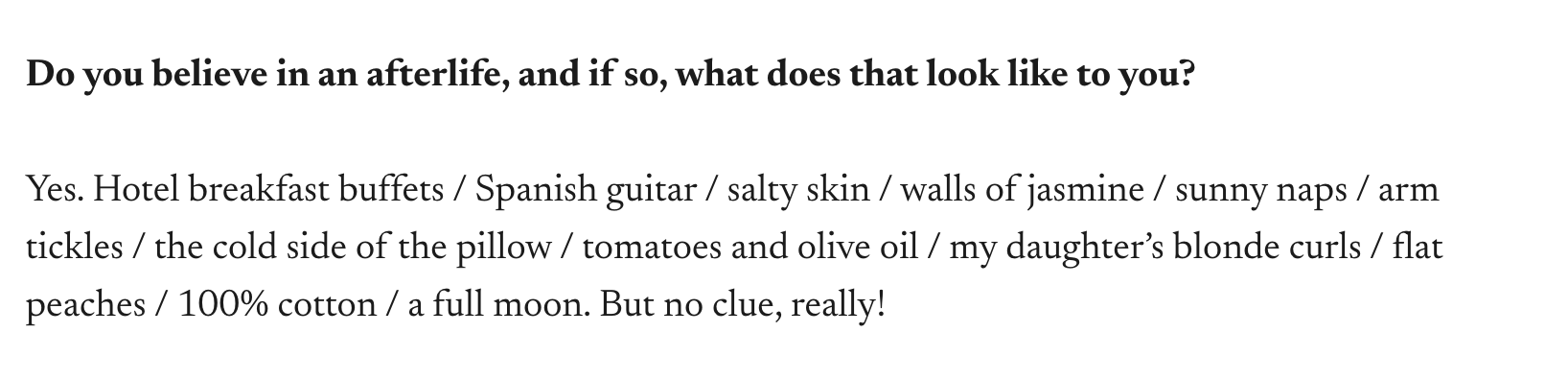
Last week, Debbie Millman interviewed Kate for her “What Matters” series in PRINT magazine – an effort to understand the interior life of artists, designers, and creative thinkers – and the questions revealed feelings, thoughts, ideas that in our 10+ years of knowing one another I’ve never known.
Sometimes asking better questions isn’t about getting deeply personal but reframing a standard question by asking someone about what others think. Not “why should I hire you” in an interview but “who knows you best and if they were here, why would they say to hire you?”
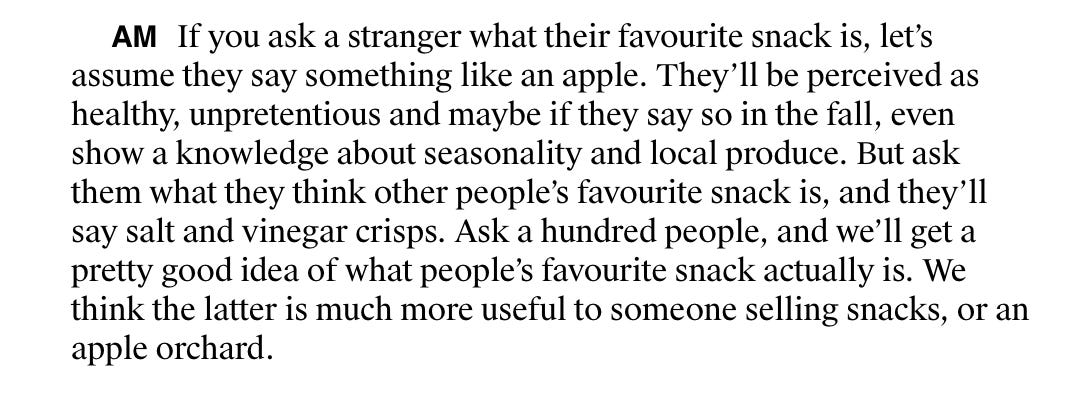
In thinking about this newsletter we resurfaced an article Kate shared a while ago from the research agency Early Studies (the first thing their website says is The Answer is Better Questions!). It was an interview with AUFI talking about a kind of social surveying where instead of asking people what they think about something (a product, a behaviour, a cultural phenomenon) they ask what they believe others think.
“Humans greatly overestimate how much we know about ourselves, and underestimate how much we know about those around us. When asked to predict the behaviours, feelings or preferences of others, we reason more rationally and apply generalisation we think we ourselves are often exempt from.” By switching up the question they reveal a deeper truth.
A couple of years ago, when hiring, a very kind person passed on a list of questions that had been passed on to them to ask in job interviews to go deeper into their character, which we’ve used since. To pay it forward, we thought we’d leave a list of questions for you too.
In an interview with a potential job candidate
Who knows you best in the world and why would they say to hire you?
If I asked you what made you frustrated, what would they say?
When was the last time you felt really happy and why?
If you had to narrow it down, what are three things you’re very good at? And how do you know you’re good at them?
Tell me about something you’ve recently learned?
If you weren’t doing this job, what would you be doing?
Asking the interviewer questions back
What part of this job gives you the most energy?
What about your job keeps you up at night?
When was a time you felt really supported by your team? And the least supported?
How has this job changed you personally?
What do you wish you had more time for in your role?
Interviewing stakeholders for a brand brief
What’s the part of this business or brand that you wish didn’t exist?
What’s the biggest tension between what we say we do and what we actually do?
What’s a customer complaint you hear often that secretly has truth in it?
If you were our competitor, what weakness would you exploit?
If this brand disappeared tomorrow, what would the world genuinely lose?
What would your family or friends say that you do?
Interviewing customers about your/a brand
If our brand/product was an animal what would it be?
What do you wish our brand understood better about your life?
What are yourdeepest fears about our product?
How do your friends feel about X?
What do you think is most important to your friends when it comes to X (fashion, beauty, health etc)
How would you tell your friends/family about us? What would convince them to try?
Who do you think buys our product? Do you fit in with them?
Dinner conversation
It’s nice to sit next to a stranger. Any secrets you want to get off your chest?
Who would you be most likely to date at this table?
When was the last time you really got angry?
That smells delicious…if you were a smell what would you be?
What was the last thing you and the host/bride/groom/birthday girl disagreed on?
How happy are you at this age? What would make you happier?
How’s your sex life?
The Vortex
How have you gotten over heartbreak? What makes you cry? Read our co-founder Kate’s answers for Debbie Millman’s ‘What Matters’ Series.
We finally got our hands on an Octopus Legacy box this week, and it got us thinking about what we’d want to leave behind. The Get Closer card game is a lesson in better questions. We wrote about the box and the work we did here.
Proust believed that answering these questions revealed your true nature. Vanity Fair made a column out of it.
What’s one thing you really believe in? What do all your exes have in common? We’re Not Really Strangers is the card game all about creating meaningful connections (and playing it is a masterclass in asking better questions). Their socials are good too.
Are personality tests the astrology of the corporate world? And do they actually work?
🫡 got it, gonna ask my next interviewer about their sex life